 Hotline Free:
(+1) 302-319-8696
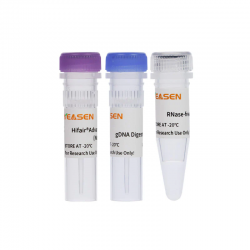
Hifair™ AdvanceFast 1st Strand cDNA Synthesis SuperMix for qPCR (gDNA digester plus) is an upgraded version of Hifair™ Ⅲ 1st Strand cDNA Synthesis SuperMix for qPCR (gDNA digester plus). Compared to the previous generation Hifair™ Ⅲ Reverse Transcriptase, this product exhibits enhanced tolerance to inhibitors, faster reverse transcription speed, and higher cDNA yield, making it suitable for reverse transcription reactions of RNA from animals, plants, and microorganisms. The gDNA Digester Mix -V2 included in this product has been significantly improved in its ability to remove residual DNA, effectively digesting up to 1000 ng of DNA, ensuring more reliable results by eliminating DNA contamination in RNA templates.
Hifair™ AdvanceFast SuperMix contains all components required for reverse transcription. Simply add RNA template and RNase-free H2O to initiate the reaction, while simultaneously terminating the activity of gDNA Digester to ensure cDNA integrity.
The reverse transcription products are suitable for dye-based and probe-based qPCR. However, they are not recommended for long-fragment amplification such as gene cloning. For such applications, Hifair™ AdvanceFast 1st Strand cDNA Synthesis Kit (Cat#11150ES) is recommended for high-efficiency reverse transcription.
|
Components No. |
Name |
11155ES10 |
11155ES60 |
|
11155-A |
Hifair™ AdvanceFast SuperMix |
60 μL |
600 μL |
|
11155-B |
gDNA Digester Mix -V2 |
20 μL |
200 μL |
|
11155-C |
RNase Free H2O |
200 μL |
2×1 mL |
This product should be stored at -25~-15℃ for 1 year.
RNA Detection
1. Workflow: Fast &Simple

Figure 1. Workflow Comparison: 11155ES completes reverse transcription in just 5 minutes (total time ~7 minutes), significantly faster than common reagents (~17 minutes).
2. High-Efficiency Synthesis – Superior cDNA Yield Across Diverse Targets and Species

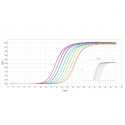
Figure 2. Reverse Transcription Efficiency Comparison
Using RNA from various sources, cDNA synthesis was carried out with different reverse transcription reagents following their respective protocols. Dye-based qPCR analysis demonstrated that 11155ES consistently produces higher cDNA yields and lower Ct values than other reagents, as reflected by the ∆Ct values.
3. High Sensitivity – Detects as Low as 10 pg of RNA


Figure 3. Reverse Transcription Sensitivity Comparison
RNA from human 293T cells and Arabidopsis thaliana was serially diluted to different input amounts. cDNA synthesis was performed using various reverse transcription reagents according to protocols, followed by qPCR with Yeasen dye-based qPCR reagents. The ∆Ct [Ct (other reagents) – Ct (11155ES)] values indicate that, compared to other reverse transcription reagents, 11155ES consistently delivers better performance across a range of RNA inputs.
4. Enhanced gDNA Removal – More Effective Residual DNA Digestion

Figure 4. gDNA Digestion/Removal Capability Comparison
Genomic DNA (1000 ng) from human 293T cells was used as the template. Various reverse transcription reagents were tested following their respective protocols, with parallel groups set up without gDNA digestion. Reverse transcription was then performed, followed by qPCR using Yeasen 11185ES. The results indicate that the reagent effectively digests and removes residual gDNA.
5. Strong stability

Figure 5. Stability Test
(A) Performance after repeated freeze-thaw cycles. Reverse transcription was performed using reverse transcription reagents subjected to 0, 10, 20, or 30 freeze-thaw cycles, followed by dye-based qPCR. The resulting Cт values of samples subjected to 10–30 freeze-thaw cycles showed minimal variation compared to the control (0 cycles), with differences no greater than 0.5 Cт.
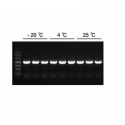
(B) Stability under different storage conditions. The stability of synthesized cDNA was evaluated after storage under various conditions. cDNA generated with product 11155ES was stored for 1 to 7 days at –80 °C, –20 °C, 4 °C, 25 °C, and 37 °C, respectively, prior to qPCR using Yeasen dye-based qPCR master mix. The data indicate that Cт values obtained from samples stored under non–80 °C conditions were highly consistent with those stored at –80 °C, differing by no more than 0.5 Cт.
1. This product is for research use only.
2. Please operate with lab coats and disposable gloves,for your safety.
3. Perform all pipetting and mixing steps on ice to maintain sample integrity.
4. Gently invert and centrifuge each component at low speed before use to ensure proper mixing.
Q:Is it necessary to add additional primers during reverse transcription?
A:This product is subsequently used for qPCR of common RNA. Random primers N6 and Oligo dT have been added in a certain proportion in the reverse transcription premix, so no additional primers are required. If qPCR or long fragment PCR for special RNAs such as small RNAs or circular RNAs is to be conducted subsequently, it is recommended to use the separate primer reverse transcription kits 11139ES or 11149ES.
Q:How did you mix the reagents before?
A:For molecular enzyme reagents, simply invert and mix them together, then perform a gentle centrifugation. It is not recommended to vigorously shake to mix them.
Q:What is the range of RNA input that the 11155ES can accommodate?
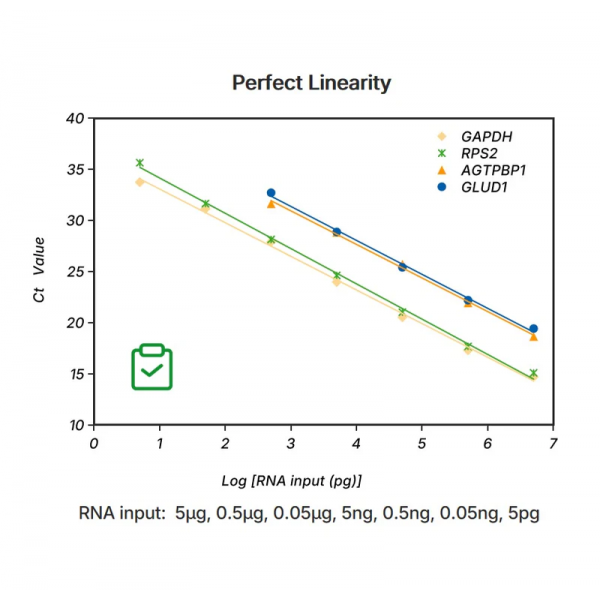
A:The 11155ES can accommodate RNA input ranging from 10 pg to 5 μg. However, an excessively high RNA input does not necessarily lead to a more forward Ct value. Additionally, an excessively high input of self-prepared RNA also brings about residual other components. These inhibitory components remaining in the reverse transcription product may inhibit the subsequent qPCR reaction, resulting in an increased Ct value, fluctuation of the curve, or precipitation of the product. Ultimately, it is necessary to dilute the cDNA for use to achieve the final result.
Q:Could a longer reverse transcription time be considered?
A:It is not recommended to use a longer reverse transcription time. Using a longer time may cause the Ct value to be delayed. It is recommended to follow the procedure suggested in the manual.
Q: After the reverse transcription is completed, can it be left in the PCR instrument for a long time?
A:For the PCR instrument, proper settings should be made. It is recommended to set the temperature at 4℃ for an infinite duration (∞) after the reaction is completely terminated. This is to prevent the possibility of forgetting to remove the tube after the reaction is completed. The PCR hot lid, through heat conduction, keeps the product in a high-temperature heating state.
Q: After the reverse transcription is completed, is it necessary to measure the concentration and adjust it to a certain level before conducting the fluorescence quantitative PCR?
A:No need. The reverse transcription product is usually a mixture, besides the cDNA product, there are also residual RNA, proteins, salt ions, dNTPs, etc. Among them, dNTPs cause significant interference for the determination using a microplate spectrophotometer, and the final measured value obtained from the product determination is not the concentration of the product. The equal amount level has been controlled and added in the RNA section before reverse transcription.
Q:After reverse transcription is completed, if the resulting product is not used in time and is not returned to the refrigerator, will it have any impact on the experiment?
A:The product has been tested and found to be stable for one week at room temperature without any adverse effects. Therefore, it can be used to complete the subsequent experiments.
Q:If the reagent is opened but not fully used, can it be stored at 4℃?
A:After opening, ensure that the reagents have not been contaminated by the syringe tips. Then, they can be stored at 4℃. However, it is recommended to use them up within 2 weeks.
Q:When conducting subsequent fluorescence quantitative PCR, which model of reagent do you recommend to pair with it?
A:It is recommended to pair with 11188-11190ES.